At the 34th European Vegetation Survey Conference in Clermont-Ferrand, Pl@ntNet PhD student Giulio Martellucci presented new research results showing how historical vegetation-plot data can help artificial intelligence identify plants in complex natural communities.
From 7 to 11 Sept. 2026, vegetation scientists from across Europe gathered in Clermont-Ferrand, France, for the 34th European Vegetation Survey Conference (https://34evs2026.org/). Entitled “Historical Data, Dynamics and Conservation”, the conference explored how vegetation records can support ecological research, biodiversity monitoring, conservation and restoration.
During the session dedicated to vegetation monitoring and biodiversity conservation, Giulio Martellucci presented a work entitled “Leveraging the European Vegetation Archive to Resolve Visual Ambiguity in Automated Biodiversity Monitoring”
This work, carried out as part of Giulio’s PhD (involved in Pl@ntAgroEco project), brings together computer vision and vegetation science to address one of the main challenges facing automated biodiversity monitoring: identifying multiple plant species within complex images of real vegetation.
Why plant communities remain difficult for artificial intelligence ?
Deep-learning models have made remarkable progress in identifying plants from photographs, particularly when an image shows a single, clearly visible specimen. Natural plant communities, however, present a much harder problem. A photograph taken in a grassland, forest or wetland may contain many species growing together. Plants can overlap, appear only partially in the image or be observed under difficult lighting conditions. Closely related species may also share very similar visual characteristics, making them difficult or sometimes impossible to distinguish from appearance alone.
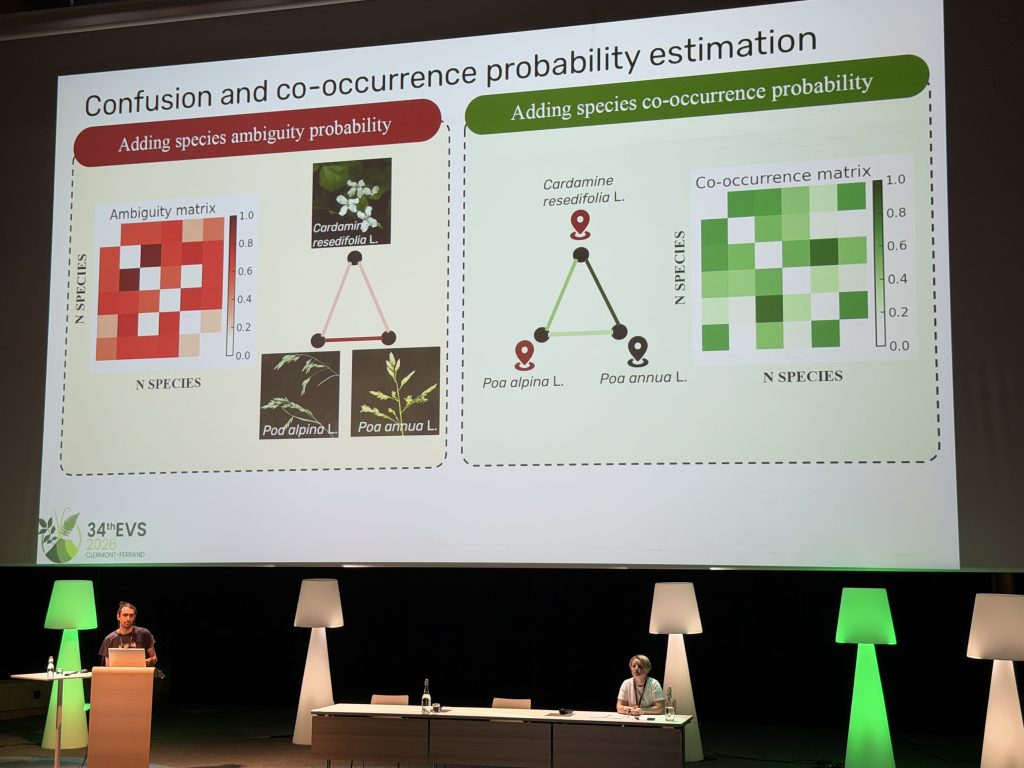
Giulio’s research investigates how ecological information can help resolve this visual ambiguity. In his study he takes into account the fact that each species has ecological preferences and tends to coexist with some species more frequently than with others. When a visual model hesitates between several possible identifications, information about which plants are likely to occur together can provide an additional and ecologically meaningful clue.
This research was developed through a collaboration with the European Vegetation Survey Working Group (https://euroveg.org/), which manages the European Vegetation Archive, or EVA (which aims to establish and maintain a single repository of vegetation-plot observations from Europe and adjacent regions).
In the framework presented by Giulio, two complementary sources of information are combined: Visual information (coming from Pl@ntNet model inferences), and Ecological information (derived from EVA vegetation plots).
Used together this information allows to generate a “corrective layer”, helping the Pl@ntNet AI model choose between visually plausible alternatives species, when applied on vegetation plots. Giulio’s doctoral research builds on a broader scientific collaboration between the EVA and Pl@ntNet communities.
Vegetation-plot data from EVA previously contributed to the work led by César Leblanc and published in *Nature Plants* under the title “Learning the syntax of plant assemblages” (https://www.nature.com/articles/s41477-025-02105-7). Giulio’s work explores a complementary direction: using knowledge of plant assemblages to improve species identification directly from images. Together, these projects demonstrate how historical ecological records and recent advances in artificial intelligence can reinforce one another.