Pl@ntNet is often associated with its plant identification system, which is indeed its most visible and widely recognized feature. However, the platform now relies on three closely connected components: an AI-based plant identification tool, a community of several million users who produce and share botanical observations around the world, and a biodiversity dataset that has gradually become a major scientific resource. But in 2026, what are the data produced through Pl@ntNet actually used for?
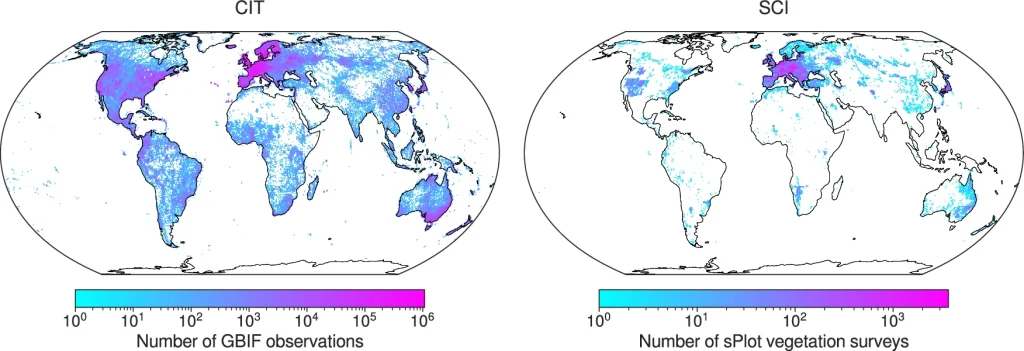
Lusk, D., Wolf, S., Svidzinska, D. et al. Crowdsourced biodiversity monitoring fills gaps in global plant trait mapping. Nat Commun 17, 1203 (2026). https://doi.org/10.1038/s41467-026-68996-y
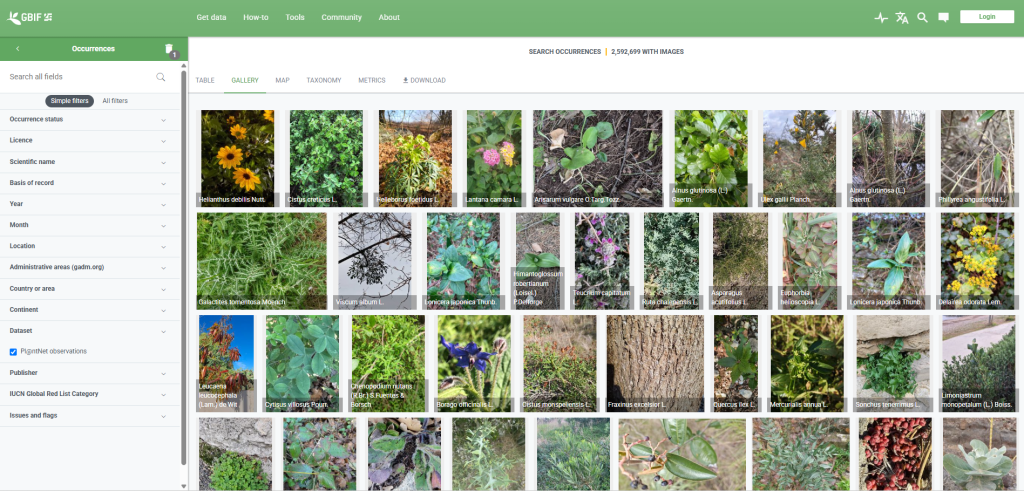
The data shared by Pl@ntNet, particularly through the GBIF (Global Biodiversity Information Facility), has played an increasingly important role in plant biodiversity research over the past several years. Generated from millions of observations contributed by platform users, these data now go far beyond the scope of a simple plant identification app. They are used in research fields including ecology, conservation biology, biogeography, environmental modelling, and artificial intelligence.
Since 2020, initially as part of the European Cos4Cloud project, Pl@ntNet has regularly contributed its most reliable observations to GBIF, including both community-validated observations and automated identifications associated with very high confidence scores. This open-data strategy has enabled these datasets to be reused in more than 1,500 international scientific publications.
This contribution was recently highlighted in a paper published in Nature Communications in January 2026. In this study, citizen science data, including observations originating from Pl@ntNet through GBIF, were integrated with major reference datasets such as TRY and sPlot in order to produce high-resolution global maps of plant functional traits. TRY is an international database compiling measurements of plant functional traits collected from field studies, such as leaf size, wood density, or seed mass, while sPlot gathers vegetation surveys conducted on standardized plots worldwide to describe plant community composition. The study shows that these data help fill major geographical gaps in regions still poorly covered by traditional scientific inventories, particularly tropical, mountainous, or historically under-sampled areas. The authors also emphasize that platforms such as Pl@ntNet now contribute to the production of so-called “research-ready” data, directly reusable in large-scale scientific analyses. In particular, these datasets improve the spatial coverage of ecological models, strengthening their ability to represent regions where field data remain scarce.
These citizen science data also play a structural role in the production of global maps of plant functional traits, including leaf size, wood density, and seed mass. Such variables are essential for understanding how ecosystems function and respond to climate change. The contribution of datasets originating from platforms such as Pl@ntNet therefore goes beyond simply enriching existing databases: it directly modifies the ability of models to represent living systems at a global scale.

However, the uses of these data are not limited to ecology. This convergence between citizen science, botanical expertise, and artificial intelligence contributes to the development of tools capable of analyzing biodiversity at very large scales across highly diverse ecological contexts. More broadly, the open and standardized dissemination of data through GBIF enables their reuse in international scientific projects dealing with climate change, invasive species, and large-scale ecological dynamics. The Nature Communications paper also reminds us that such scientific advances rely both on open biodiversity data infrastructures and on the communities of contributors who continuously feed citizen science platforms such as Pl@ntNet.
In just a few years, Pl@ntNet has become much more than a plant identification tool. The platform now helps support the infrastructure upon which global scientific research dedicated to observing and understanding biodiversity relies. For readers wishing to explore these topics further, Pierre Bonnet and Alexis Joly, coordinators of the Pl@ntNet platform, recently discussed the evolution of Pl@ntNet and the role played by citizen science in biodiversity research in an article published in The Conversation. We previously highlighted this discussion on our platform, but we especially encourage readers to take the time to explore the full exchange in its entirety.