A key local stakeholder for biodiversity in Agde
ADENA is an association dedicated to nature conservation and environmental awareness, with expertise in Mediterranean coastal wetlands. Located at the crossroads of the Thau Basin and the Hérault Valley, it is based in the town of Agde, in the Occitanie region of France.
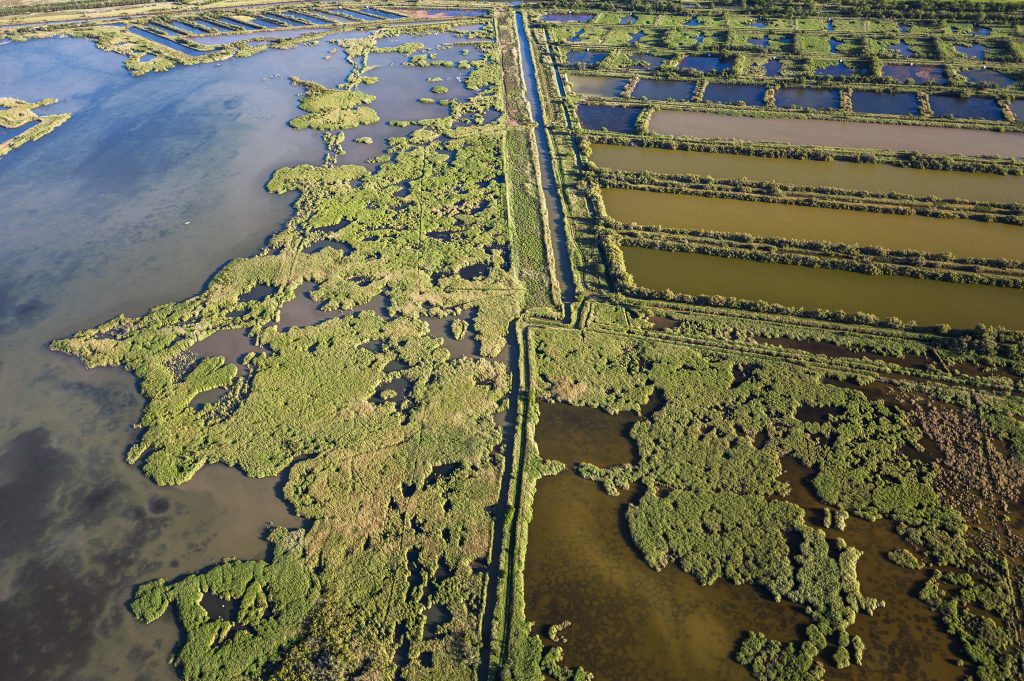
ADENA has built its local activities around the Bagnas National Nature Reserve, which it has managed since its creation in 1983. Since then, other protection schemes have expanded and strengthened the Bagnas site: land acquired by the Conservatoire du Littoral in 1998, and Natura 2000 designations in 2004 (Special Protection Area) and 2006 (Special Area of Conservation). Thus, for nearly 40 years, ADENA has been protecting, managing and promoting the Bagnas site, in consultation with local stakeholders.
Today, ADENA’s scientific and educational expertise extends across a wider area, encompassing ecosystems connected to the Bagnas. It is actively involved in projects focused on wetland conservation and works in partnership with local and national scientific, naturalist and environmental education networks.
The Bagnas site is home to a mosaic of habitats characteristic of Mediterranean coastal wetlands. It supports significant biodiversity thanks to a wide variety of natural environments (lagoons, sansouïres — salt-tolerant shrublands —, salt meadows, etc.), and is therefore home to a very rich range of fauna and flora, including birds, reptiles, amphibians and plants.
ADENA’s mission is to manage, preserve and promote the Bagnas, which requires a detailed understanding of the site. To build this knowledge, the ADENA team relies on scientific monitoring (regular, standardized, long-term data collection) and naturalist surveys (periodic records of the species present). This knowledge enables ADENA to assess and adapt its actions in order to achieve the objectives set out in the management plan.
ADENA also actively manages the habitats under its responsibility: maintaining natural areas, monitoring the sites, removing invasive alien species, collecting waste, and installing fences to facilitate grazing. Finally, it raises public awareness and provides environmental education activities for visitors and school groups, making the natural wealth of these areas accessible to all. This activity lies at the heart of a philosophy that we share at Pl@ntNet, which places citizens and local stakeholders at the center of biodiversity conservation.
A key partner for Research and Pl@ntNet
Against this backdrop, the collaboration between ADENA and Pl@ntNet is part of a shared effort to improve knowledge of plant biodiversity, but above all to test innovative tools on a real-world scale for biodiversity monitoring. It was in this context that, in 2023, the Bagnas joined the European MAMBO project as an experimental site. Over a period of three years, MAMBO brought together European research institutes, universities, protected-area managers and artificial intelligence specialists around a common goal: to develop and improve a range of biodiversity monitoring tools. These tools were designed to be more automated and standardized, while remaining affordable to deploy across Europe’s diverse ecosystems, climates and habitats. Their aim was to improve knowledge of species while meeting the operational needs of site managers and the accessibility requirements of policymakers.
Within this consortium, Pl@ntNet played a central role. Beyond its recognized expertise in automated plant identification, Pl@ntNet contributed to the development and evaluation of several essential technological components of the project. In particular, it participated in the design of AI-based image analysis tools capable of automatically identifying plant communities from photographs of quadrats, estimating species cover and standardizing vegetation surveys. This tool is none other than the Pl@ntNet Plots feature, now available on the web version of the platform. Together with ADENA, Pl@ntNet also played a facilitation role in the field deployment of technologies developed by other MAMBO consortium partners and in their evaluation under real-world conditions.
The Bagnas National Nature Reserve thus became one of the project’s most important pilot sites. Several experimental protocols were implemented there: automated monitoring of nocturnal insects using light traps equipped with cameras and computer vision algorithms; monitoring of diurnal and nocturnal pollinating insects using camera traps; and multi-taxa acoustic monitoring (birds, bats, amphibians and orthopterans) through automated sound recognition. Finally, the Bagnas Reserve provided a key setting for testing and improving Pl@ntNet through transect surveys of flora and vegetation based on quadrat images.
These systems rely on methods incorporating AI models capable of automatically detecting, tracking and identifying species from images or acoustic recordings. The resulting data are standardized, providing precise quantitative information on both species presence and abundance, while significantly reducing the time required to collect and process the data. Indeed, these activities were previously carried out manually and required a substantial investment in both time and expertise. Deploying these technologies at the Bagnas not only made it possible to assess their robustness in a Mediterranean context — some of these technologies having initially been developed for colder environments — but also to compare their performance with more traditional monitoring methods. ADENA’s expertise as a natural-area manager also brought greater methodological depth to these experiments: these are not simply research tools, but technologies developed with operational users in mind, particularly those dealing with the day-to-day realities of managing natural areas.
The results emerging from MAMBO are particularly promising. The protocols have already helped improve knowledge of several groups that remain insufficiently documented, particularly nocturnal moths, while validating the use of these new tools under a variety of field conditions. In the long term, these innovations should strengthen the biodiversity monitoring capabilities of natural-area managers by providing more consistent methods that can be deployed on a large scale and at significantly lower cost.
This collaboration also fully illustrates the complementarity between researchers and natural-area managers. Thanks to ADENA’s expertise and commitment, the technological developments led by Pl@ntNet, and the contributions of all the MAMBO partners, the Bagnas has become a genuine testing ground for us to explore new approaches to biodiversity monitoring. We now hope to continue this collaboration through future initiatives and to maintain a strong and sometimes all too rare connection between researchers and people working directly in the field.