Pl@ntNet aims to provide fast, simple, and collaborative access to botany in everyone’s pocket. This mission of democratizing and co-producing knowledge with our community enables us to take part in ambitious research projects whose ultimate goal is to continue developing Pl@ntNet’s capabilities and features.
We previously told you about GeoPl@ntNet, the mapping platform that can predict plant species and habitats across continental Europe, as well as Pl@ntNet Plots, a feature that allows users to identify several plants in a single photo. But did you know that, since February 2026, a new feature has been available on Pl@ntNet? The “Diseases & Pests” feature.
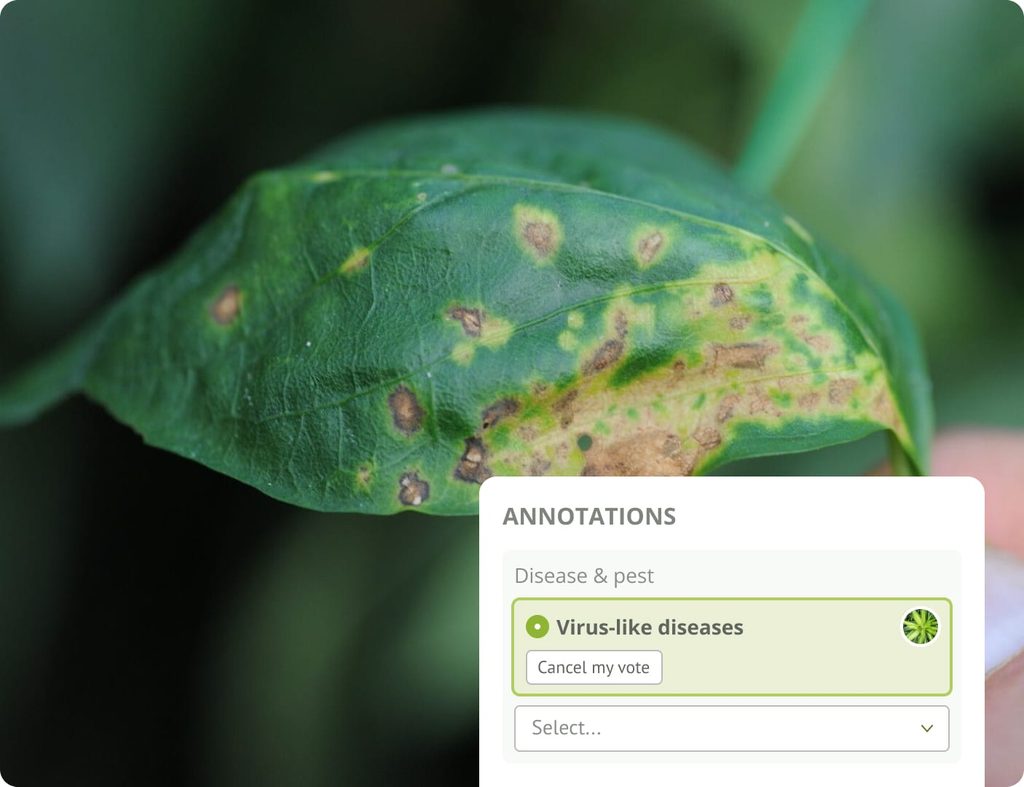
Developed as part of the Pl@ntAgroEco project, “Diseases & Pests” was designed first and foremost to address the needs of farmers and professionals across the agricultural sector: growers, farmers, agricultural technicians, plant pathologists, agronomists and others. Like Pl@ntNet’s standard identification feature, “Diseases & Pests” allows users to identify the disease or pest affecting a plant from a simple photograph of its symptoms.
This development is the result of collaborative work between Pl@ntNet and several French and international research units. Pl@ntAgroEco is a project part of the PEPR AgroEcoNum (France 2030). The collaboration also involves Tela Botanica, a key player in the French botanical community. Pl@ntAgroEco also has international partners, including Swinburne University, which has been actively involved in developing this new approach to identifying plant diseases and pest damage.
The application is now available to the general public and already includes 395 illustrated diseases and types of pest damage, providing a rich knowledge base to help both experts and amateurs identify plant health issues. This database draws in particular on a large-scale dataset compiled and standardized as part of the research carried out within Pl@ntAgroEco. To date, just over one hundred plant species are covered. To begin with, we chose to focus primarily on key crops in France, as well as on species for which our partners could provide us with high-quality data. Some crops are therefore already particularly well represented, including rapeseed, coffee and grapevine, for example.
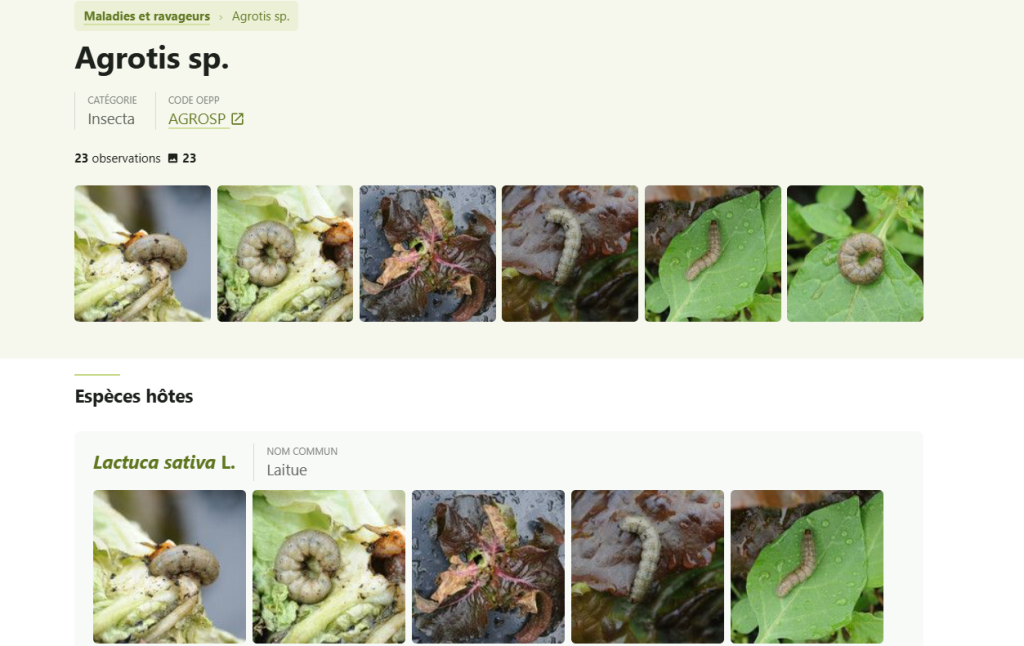
But to continue improving the performance of this new feature, expand its coverage and enable the model to recognize different plant health issues more accurately from their symptoms, we need to continue collecting high-quality data. For an AI model like ours, the quantity and diversity of the available data are essential. The more the model is trained on a large number of observations, as well as on different cases and contexts, the more we can expect reliable and robust identification of diseases and pest damage.
We are therefore looking for plant pathologists, specialists in specific diseases or pests, as well as experts in plant health and the plant sciences, to help enrich this database! Their expertise is essential for providing images of diseased or infested plants, more accurately identifying the symptoms observed, and correctly annotating the corresponding diseases or pests. The more the model has access to reliable, diverse, and accurately identified data, the more it can refine its knowledge and improve its performance, particularly when dealing with symptoms or diseases for which we do not yet have enough data. The lack of high-quality visual data is currently one of the main limitations to the development of this feature. Expert contributions therefore play a central role in improving the feature and its performance, as well as progressively expanding the number of species and plant health issues it can recognize. Ultimately, the goal is to provide increasingly broad coverage and a more relevant tool for both professionals and amateurs.
This expert data is an essential resource for progressively training and improving this work. In short, it follows the same participatory principle that has always been at the heart of Pl@ntNet: users are the cornerstone of the platform.
If you would like to take part in this initiative and help us improve the results, you can use the following address to contact us and request the protocol detailing the different steps involved in participating in this collaborative effort: contact@plantnet-project.org